

Microsoft Ushers in a New Era in Artificial Intelligence: Seven New “MAI” Models and Industry Solutions Announced
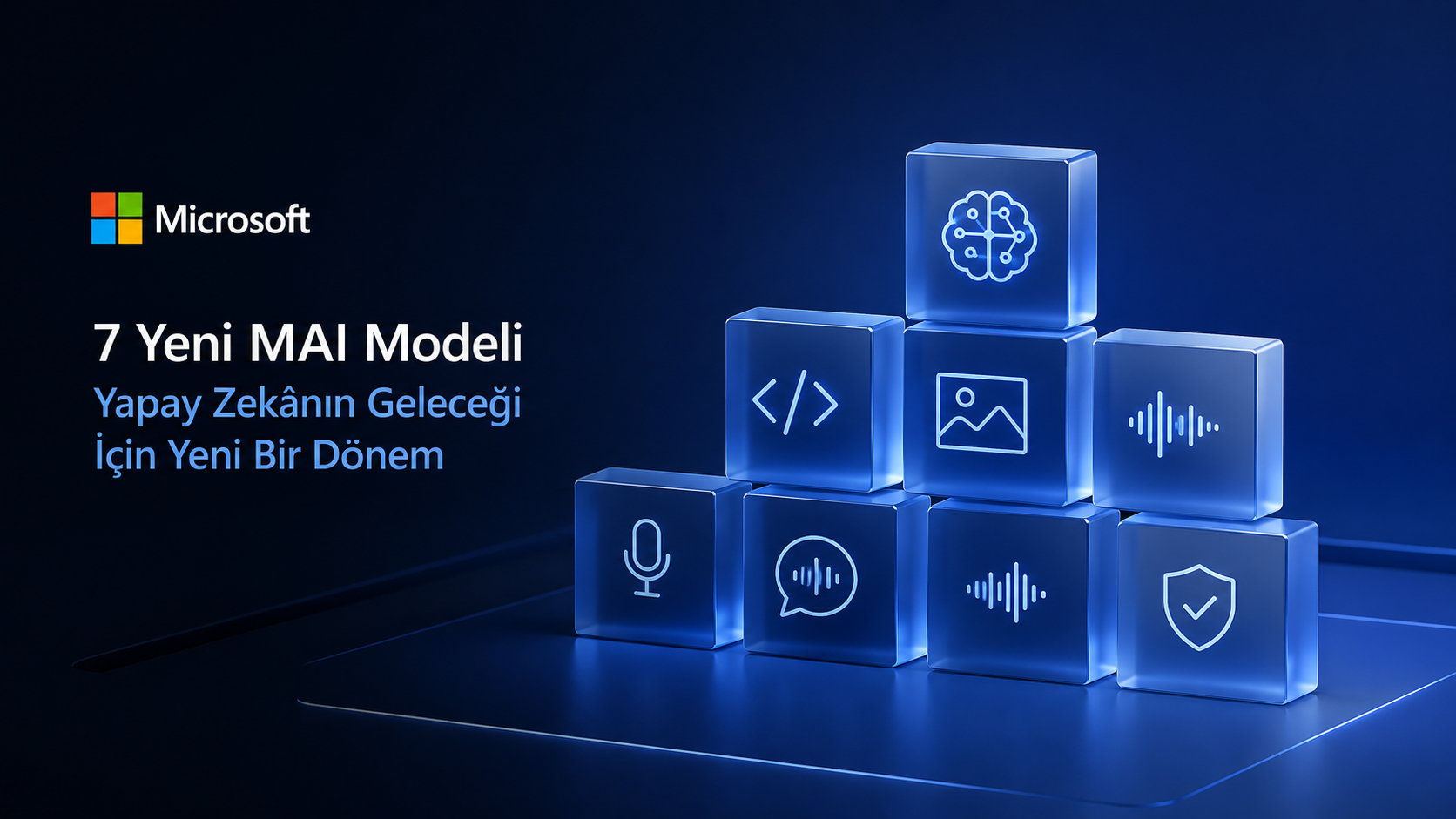
The technology world is witnessing another historic turning point in the field of artificial intelligence. According to the official announcement made by Microsoft AI (MAI) CEO Mustafa Suleyman, the company has unveiled the “MAI” model family, consisting of seven new native artificial intelligence models focused on image, voice, transcription, coding, and reasoning capabilities. Operating with the vision of a “supercomputing lab,” Microsoft also presented the “Frontier Tuning” architecture, which directly integrates artificial intelligence into the operational processes of enterprises, and a health-focused vertical AI model developed in collaboration with Mayo Clinic.
Tremendous Increase in Compute Power and Corporate Reliability
Stating that the compute capacity used in training artificial intelligence models has recently increased by a trillion-fold, Microsoft AI management emphasized that they expect another thousand-fold increase in this power within the next three years. The most remarkable aspect of MAI models is that they were trained entirely from scratch, using clean and enterprise-level licensed data. This infrastructure, developed without distillation from third-party models, aims to bring a new breath to the industry in data traceability and corporate security standards. In addition, it was announced that a 1.4-fold increase in operational efficiency was achieved thanks to the use of Microsoft’s own production “Maia 200” artificial intelligence chips.
7 New MAI Models Focusing on Real-World Solutions
The introduced multimodal MAI ecosystem is designed to offer high performance and cost advantages in the areas most needed by the business world:
-
MAI-Thinking-1: A medium-sized flagship reasoning model that delivers the strongest results in its class in advanced mathematical reasoning and software engineering benchmarks (SWE-Bench Pro).
-
MAI-Code-1-Flash: A 5-billion-parameter, fast, and low-cost coding model deeply integrated into Microsoft developer tools such as GitHub Copilot and VS Code.
-
MAI-Image-2.5 (and its Flash version): A design-oriented model that ranks high in Arena ELO scores in text-to-image conversion and image editing.
-
MAI-Transcribe-1.5: A transcription model with 43 language industry terminology support, 5 times faster than its competitors and possessing high accuracy rates.
-
MAI-Voice-2 (and the upcoming Flash version): A natural voice generation model in 15 languages, capable of providing adaptation from a short voice sample and equipped with strong security measures against misuse.
The models will be opened to the access of developers on platforms such as OpenRouter, Fireworks, and Baseten, as well as the Microsoft Foundry infrastructure for corporate customers. Thus, for the first time, software developers will be able to fine-tune model weights according to their own needs.
A New Phase in Artificial Intelligence: “Microsoft Frontier Tuning”
Microsoft introduced the “Frontier Tuning” approach, which aims for artificial intelligence to fully adapt to the internal workflows of institutions. Thanks to Reinforcement Learning environments, MAI models will be able to perform learning through companies’ own data and operational steps. The special Excel model developed with this system, which ensures that corporate memory remains entirely with the company, managed to offer GPT 5.4 level performance with 10 times lower cost and high efficiency.
Revolution in the Healthcare Sector: Mayo Clinic Collaboration
One of the most strategic announcements of the launch was the collaboration with Mayo Clinic, one of the world’s leading health systems. The two institutions are developing a “Frontier AI Model for Healthcare” by bringing together Mayo Clinic’s extensive clinical expertise and anonymized data with Microsoft’s artificial intelligence infrastructure. This model, which will be used in early diagnosis and treatment planning processes within Mayo Clinic in the first phase, will be offered to the use of the global health sector via Microsoft Foundry after its validation. The ownership of the model and data control will remain entirely with Mayo Clinic.
Humanist Superintelligence Vision
The Microsoft AI team defines the ultimate goal of all this technological leap as “Humanist Superintelligence”. It is emphasized that the developed advanced artificial intelligence systems are designed not to replace human power, but to remain as advanced “tools” serving human will, supervision, and corporate goals. Publishing security and technical reports transparently, Microsoft will continue to increase its operational capacity rapidly with the new generation Nvidia GB200 cluster systems that will go into operation next year.
